
The Fastest Path to Adoption of Agentforce— Make it more than a “Bolt-on.”
By Patrick Martin | Principal at Eigen X and Dr. Christopher Crosby | Founder of Adoptlab
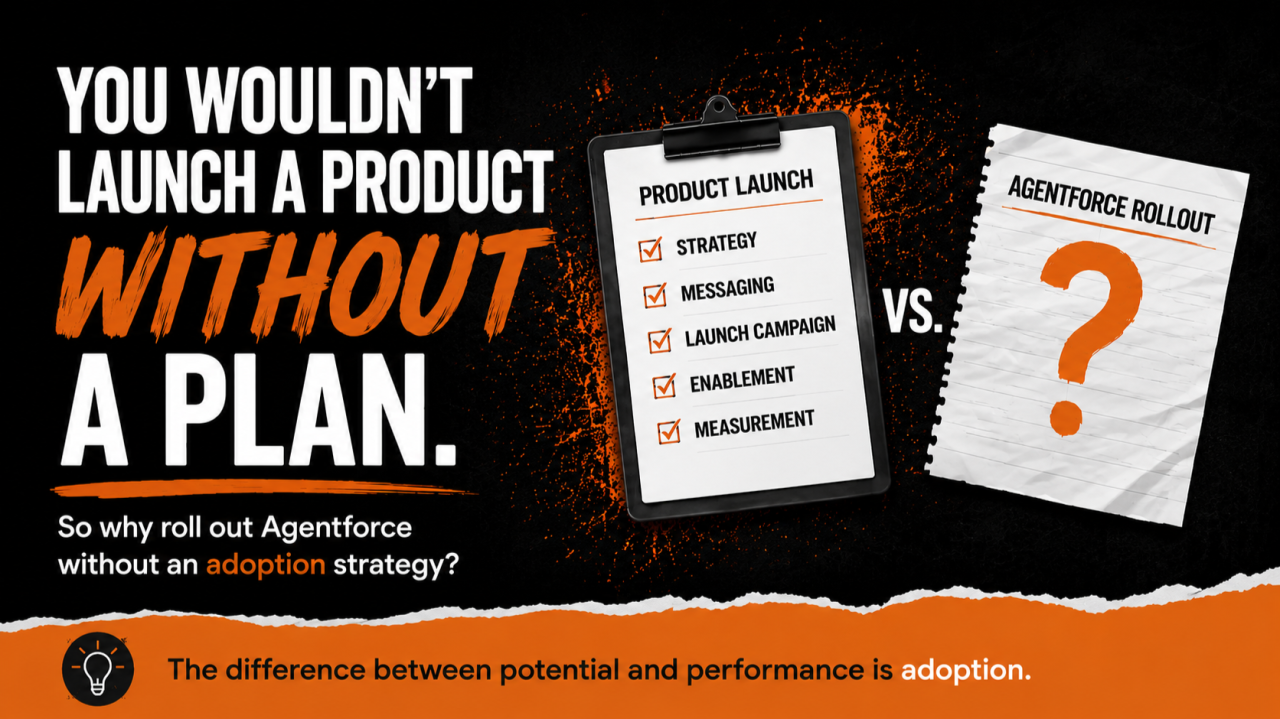
One of the most powerful and underutilized adoption strategies is recognizing that Agentforce isn't something you bolt on. Most employees aren't motivated by corporate AI strategies—they're motivated by succeeding in their role. If users don't see a direct connection between Agentforce and their performance, they'll continue to rely on the behaviors that have historically helped them achieve results. Organizations drive adoption when they clearly demonstrate how Agentforce helps employees work smarter, achieve goals faster, and improve their individual performance outcomes.
Most organizations roll out AI like Agentforce with a top-down message: “This will make us more efficient,” or something along the lines of “It will improve our customers’ experience.” But for the people actually doing the work, it often feels like one more thing to do… on top of everything else.
That’s where adoption breaks. The reality is simple: if Agentforce doesn’t improve how someone performs in their role, it won’t stick. Period.
There’s a common pattern I see with AI adoption: initial curiosity, followed by skepticism, then quiet disengagement. Sadly, this can be measured in weeks.
In truth, AI is like every technological advancement we have ever witnessed. People don’t resist Agentforce because they don’t understand it; they resist it because they don’t see how it helps them, and no one is there to hold them accountable.
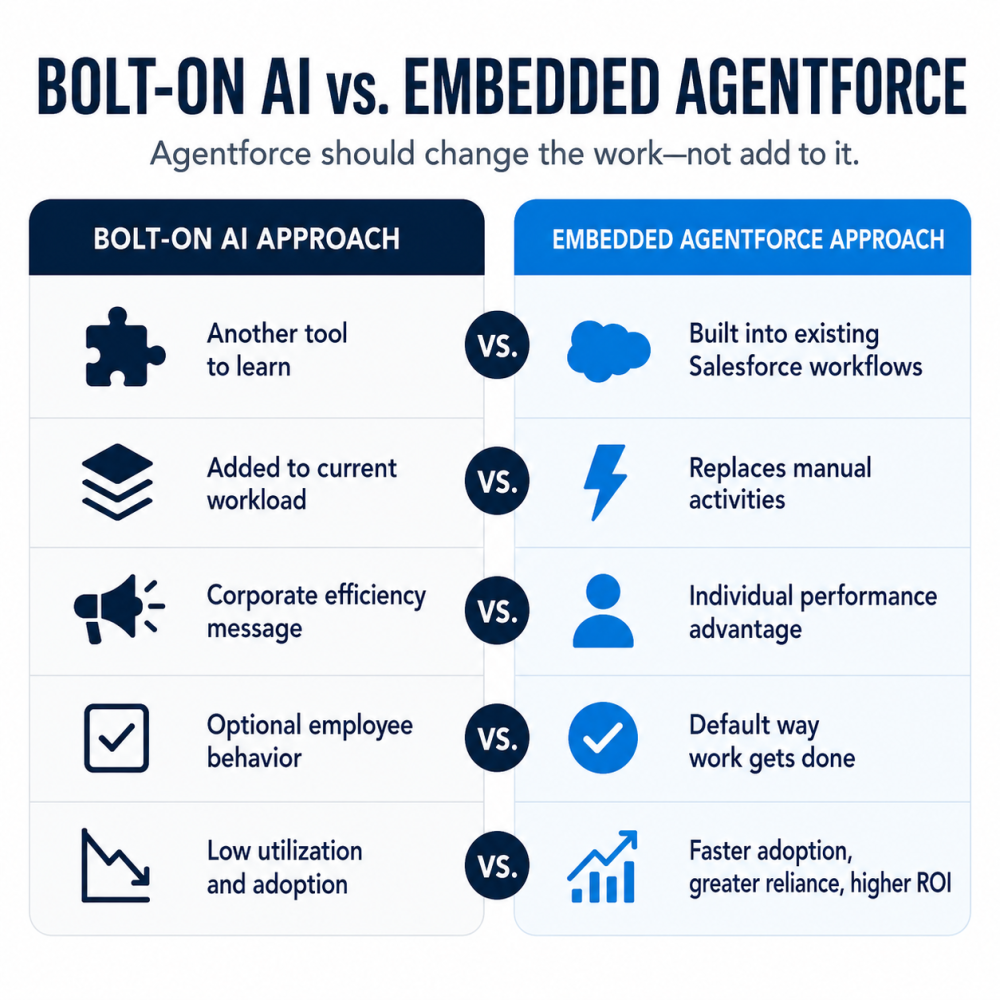
To move from resistance to reliance, Agentforce needs to become indispensable in day-to-day work. To make that happen, leaders need to shift the focus from corporate AI strategy to individual performance advantage.
Here are three ways to make that real:
1. Start where Agentforce already lives—inside your existing Salesforce flows - For organizations already running on Salesforce, it is natively embedded in the workflows your teams use every day. This is your fastest path to adoption because it doesn't require behavior change; it supercharges behavior that already exists.
Here's where Agentforce is already built in, and what it can do for end-users today:
Service Agents - Resolving cases faster without burning out your team
Agentforce Service Agents are embedded directly in Service Cloud and the Omni-Channel routing engine. They can autonomously handle inbound customer inquiries across chat, email, and messaging channels, resolving routine cases end-to-end without human intervention. For cases that need a human, the agent summarizes the full conversation history and recommends next steps before handing off, so the rep picks up mid-stride rather than starting from scratch.
A practical example: a customer contacts support about a billing discrepancy. The Service Agent authenticates the customer, retrieves the account history, identifies the error, issues a credit, and closes the case, all without a rep touching it. For your service team, this means the queue that used to require five reps at peak volume now requires two, and the three freed up are handling only the complex, high-value interactions where human judgment actually matters.
Sales Agents - Giving reps their time back to actually sell
Agentforce Sales Agents live inside Sales Cloud and are triggered directly within opportunity and lead records. They automate the research, follow-up, and administrative work that consumes a disproportionate share of a rep's day. The Sales Agent can auto-generate personalized outreach based on a prospect's CRM history and recent activity signals, draft follow-up emails after meetings using call transcripts from Einstein Conversation Insights, and proactively flag stalled opportunities with recommended actions.
A concrete use case: a rep closes a discovery call. Agentforce can quickly draft a follow-up email referencing the specific pain points discussed, update the opportunity stage, and create a task for a proposal due in five days. The rep reviews, edits in thirty seconds, and sends. The time they used to spend on post-call admin is now spent booking the next meeting.
Marketing Agents — Personalizing at scale without adding headcount
Agentforce Marketing Agents are embedded within Marketing Cloud and Data Cloud, sitting directly inside campaign and journey workflows. They can generate audience segments dynamically based on behavioral signals, create personalized content variations for different customer profiles, and autonomously monitor campaign performance, escalating underperforming segments to a marketer for review.
A real-world example: a financial services company running a nurture campaign for mortgage prospects uses Agentforce to detect when a prospect's browsing behavior signals high purchase intent. The agent automatically moves that contact into an accelerated journey, personalizes the next email with content specific to their loan type and location, and notifies the assigned advisor to reach out directly. What previously required a marketing analyst to manually monitor and intervene now happens in real time, at scale, across thousands of contacts.
Industry Agents — Embedding compliance and domain expertise directly into the workflow
Salesforce has built Agentforce agents tailored to the specific process and compliance requirements of regulated industries, including Financial Services Cloud, Health Cloud, and Public Sector Solutions. These aren't generic agents with an industry label; they are pre-built with domain-specific data models, regulatory guardrails, and process logic. In financial services, a Wealth Management Agent embedded in advisor workflows can automatically generate pre-meeting briefings that summarize a client's portfolio performance, upcoming life events, and suitability-flagged investment recommendations, saving advisors an hour of prep per client meeting.
In healthcare, a Care Coordination Agent inside Health Cloud can identify patients overdue for follow-up, draft outreach to their care team, and update care plan records, reducing the administrative burden on care coordinators so they focus on clinical interactions. In the public sector, a Benefits Eligibility Agent can guide a caseworker through an intake process, cross-reference eligibility criteria in real time, and pre-populate application records, cutting processing time significantly while reducing errors.
The common thread across all of these is that the agent is not a new system to learn. It surfaces inside the record, the queue, the journey, or the workflow the employee is already working in. Adoption doesn't require a mindset shift when the tool is already where the work happens. Leaders who map Agentforce to the specific flows their teams live in every day will see faster adoption, higher utilization, and a much clearer line from AI capability to individual performance outcomes.
2. Measure the future, not the past - Many organizations deploy Agentforce but continue evaluating employees using pre-AI performance standards. That's a recipe for low adoption.
If Agentforce is expected to improve selling, service, forecasting, or decision-making, those expectations should be reflected in performance metrics, incentives, and manager coaching. Employees need to understand how AI contributes to their success and how that success will be measured.
Organizations also make the mistake of layering AI on top of existing work instead of replacing it. When employees are expected to use Agentforce while maintaining the same manual processes and workflows, AI quickly becomes an added burden rather than a performance advantage.
The organizations seeing the greatest return from Agentforce take a different approach. They eliminate redundant activities, redesign workflows, and make AI the default way work gets done. When employees see that Agentforce helps them perform better while reducing effort, adoption becomes a natural outcome.
3. Make managers accountable - No one has more influence over an individual's performance than their direct manager. If managers aren't using Agentforce outputs in pipeline reviews, coaching sessions, or performance discussions, teams won't take it seriously. Adoption follows management behavior.
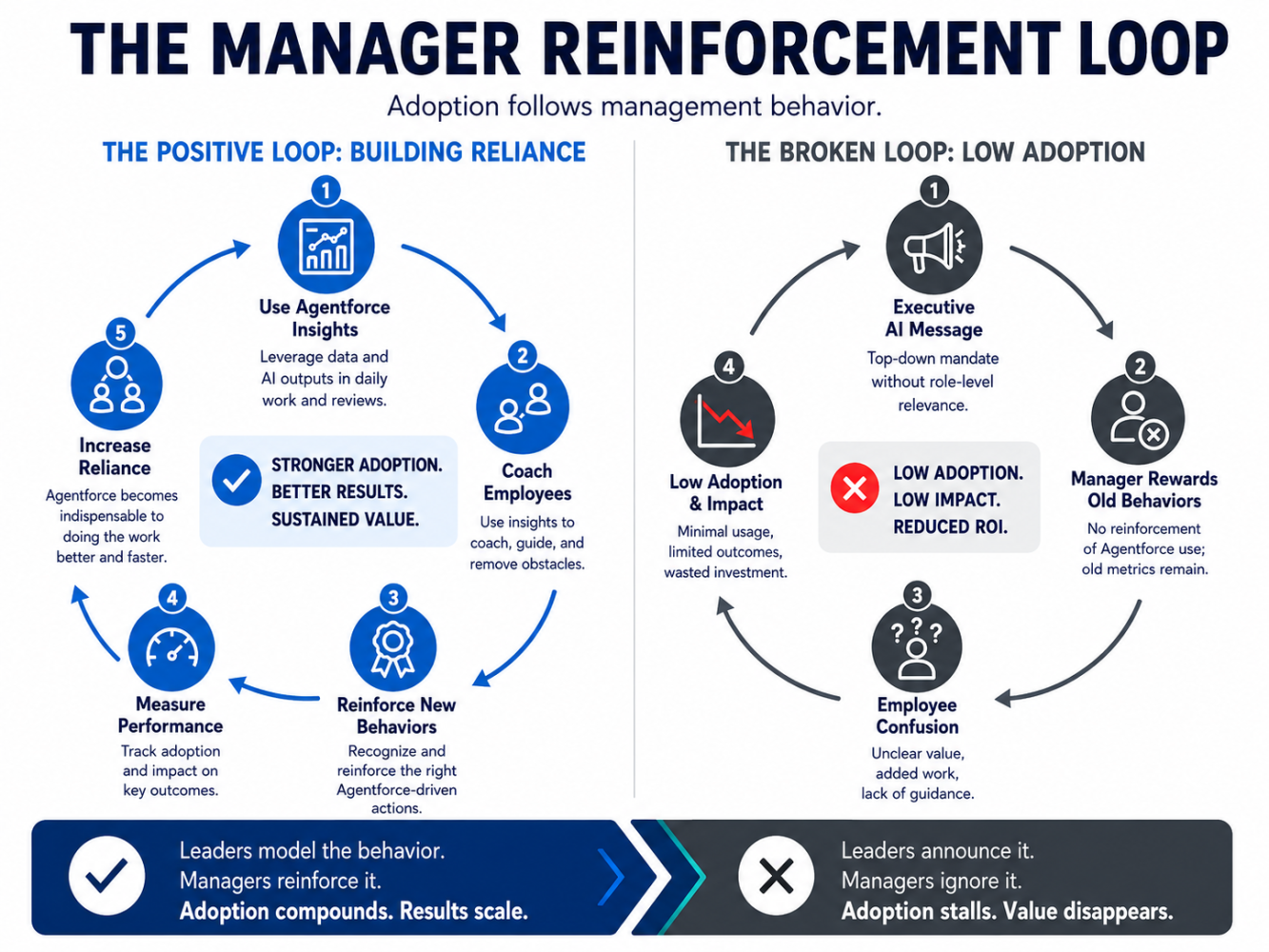
What many organizations underestimate is the significant leadership gap at the management level. Managers are expected to drive adoption, yet few have been trained in the skills required to lead behavioral change. Building trust in AI recommendations, managing resistance, reinforcing new habits, and helping employees navigate uncertainty are not traditional management competencies—but they are now essential.
When managers lack these skills, they often default to what feels comfortable: focusing on short-term performance and established routines. The result is mixed messaging. Employees hear executives talk about AI transformation while their managers continue rewarding yesterday's behaviors.
Over time, this disconnect erodes adoption, weakens confidence in Agentforce, and significantly reduces the return on the organization's AI investment.
Bringing it all together
In conclusion, the future of work will not be defined by AI itself, but by how effectively organizations help people adopt it.
Agentforce represents an opportunity to fundamentally improve how work gets done, but only if organizations move beyond traditional approaches to change. Adoption requires more than awareness. It requires aligning workflows, performance expectations, manager behaviors, and employee incentives around a new way of working.
The organizations that thrive will be those that recognize a simple truth: employees adopt tools that make them more successful. When Agentforce helps people perform better, managers reinforce its use, and leaders redefine what good looks like, AI stops being a new technology and becomes an indispensable part of everyday work.
That is the moment when adoption creates value, and value becomes a competitive advantage. That requires the right partners.
The partnership between Eigen X and Adoptlab brings together the technical and human sides of that transformation. Eigen X contributes deep expertise in Salesforce, data, integration, AI agent design, and implementation.
Adoptlab complements that capability by helping organizations redesign the employee experience, activate managers, measure adoption, and manage organizational change as a scalable, managed service rather than a temporary project.
Together, Eigen X and Adoptlab help organizations move beyond launching Agentforce to building the workflows, leadership behaviors, accountability, and adoption infrastructure required to realize its full value.
Schedule a strategy conversation.
What you should remember
Agentforce should not be treated as a bolt-on technology; it must be connected directly to how employees perform their roles and achieve measurable results.
The fastest path to adoption is embedding Agentforce within the Salesforce records, workflows, queues, and customer journeys employees already use every day.
Organizations must redesign work around Agentforce by eliminating redundant manual activities rather than adding AI to employees’ existing workloads.
Performance measures, incentives, and coaching expectations must evolve so employees clearly understand how Agentforce contributes to their individual success.
Managers must actively reinforce Agentforce through coaching, performance discussions, and operational reviews because adoption ultimately follows management behavior.
About the Authors
Patrick Martin - Principal at Eigen X, a consulting firm specializing in Salesforce, data, and analytics solutions. Patrick leads client engagement, solution strategy, and delivery for complex digital transformation initiatives, helping organizations maximize the value of their technology investments through scalable Salesforce solutions, strong stakeholder alignment, and effective project execution.
Dr. Christopher Crosby - Founder of Adoptlab, a growing organizational change management firm focused on accelerating adoption and maximizing value from enterprise technology investments through elevating the user experience and empowering managers to own their futures.
Adoptlab is a growing organizational change management firm focused on helping organizations accelerate adoption and maximize the return on enterprise technology investments. Supported by a team of more than 20 experienced change practitioners, we specialize in change strategy, manager enablement, communications, training, stakeholder engagement, and adoption measurement. Working alongside leading technology implementation partners, we help organizations turn new systems into better business performance. Visit us at adoptlab.com.